Millwright
The line startsStation 0102030405 / 05
Insight
Design for machining: six choices that set the price
Corner radii, pocket depth, tolerances and setups: where the cost of a machined part is decided.
2 Oct 2026 · 6 min read
Insight
Design for machining: six choices that set the price
Corner radii, pocket depth, tolerances and setups: where the cost of a machined part is decided.
2 Oct 2026 · 6 min read
Insight
Design for machining: six choices that set the price
Corner radii, pocket depth, tolerances and setups: where the cost of a machined part is decided.
2 Oct 2026 · 6 min read
Most of the cost of a machined part is decided before anyone cuts metal. A few choices on the drawing set the number of setups, the tools and the time on the machine. Here are the ones we see most often.
Internal corners
A milling cutter is round, so an internal corner always has a radius. Ask for a radius a little larger than a standard cutter, 3.2 mm instead of 3.0, and the tool can sweep through the corner instead of stopping in it. The finish improves and the cycle shortens.
Deep pockets
A pocket deeper than four times its width needs a long, slender tool that has to run slowly. If the depth is not functional, reduce it. If it is, widen the pocket or open one side.
Tolerances
- Put tight tolerances only on features that fit something
- Leave the rest at the general tolerance of the drawing
- Give position tolerances from datums the part can really sit on
A single ±0.005 mm bore is routine. Twenty of them on one part is an inspection project.
Setups
Every time a part is turned over, it costs handling and a small error. Features reachable from one side, or from five sides on a 5-axis machine, come off cheaper and more accurate.
If a feature is hard to draw a dimension to, it is usually hard to machine and harder to measure.
Send it early
A fifteen-minute review of an unfinished model often removes a third of the cost. We do that for free on every quote, and we mark up the drawing so you can see why.
Have a drawing on your desk?
Send it over. An engineer reads it and answers with a price and a date inside 24 hours.
Keep reading
Two more fromthe shop floor.
 01Guide24 Sep 20265 min read
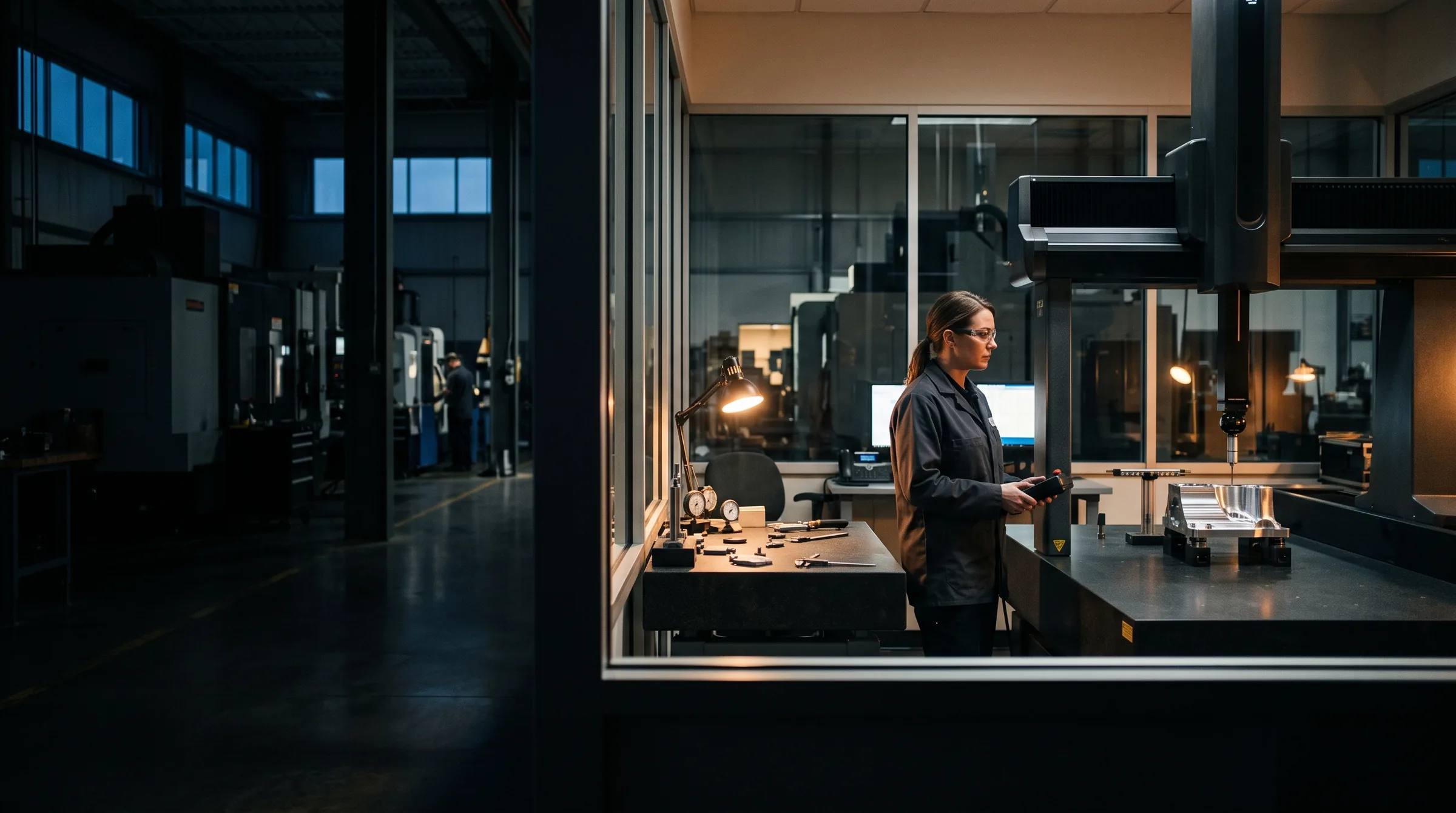
How to read a CMM report in five minutes
Thirty pages, three columns that matter. What to check and what to ask your supplier.Read the article 02Insight11 Sep 20265 min read
6061 or 7075? Choosing the aluminium grade
Two grades cover most machined parts. One welds, one is twice as strong.Read the articleMost of the cost of a machined part is decided before anyone cuts metal. A few choices on the drawing set the number of setups, the tools and the time on the machine. Here are the ones we see most often.
Internal corners
A milling cutter is round, so an internal corner always has a radius. Ask for a radius a little larger than a standard cutter, 3.2 mm instead of 3.0, and the tool can sweep through the corner instead of stopping in it. The finish improves and the cycle shortens.
Deep pockets
A pocket deeper than four times its width needs a long, slender tool that has to run slowly. If the depth is not functional, reduce it. If it is, widen the pocket or open one side.
Tolerances
- Put tight tolerances only on features that fit something
- Leave the rest at the general tolerance of the drawing
- Give position tolerances from datums the part can really sit on
A single ±0.005 mm bore is routine. Twenty of them on one part is an inspection project.
Setups
Every time a part is turned over, it costs handling and a small error. Features reachable from one side, or from five sides on a 5-axis machine, come off cheaper and more accurate.
If a feature is hard to draw a dimension to, it is usually hard to machine and harder to measure.
Send it early
A fifteen-minute review of an unfinished model often removes a third of the cost. We do that for free on every quote, and we mark up the drawing so you can see why.
Have a drawing on your desk?
Send it over. An engineer reads it and answers with a price and a date inside 24 hours.
Keep reading
Two more fromthe shop floor.
01Guide24 Sep 20265 min readHow to read a CMM report in five minutes
Thirty pages, three columns that matter. What to check and what to ask your supplier.Read the article02Insight11 Sep 20265 min read6061 or 7075? Choosing the aluminium grade
Two grades cover most machined parts. One welds, one is twice as strong.Read the articleMost of the cost of a machined part is decided before anyone cuts metal. A few choices on the drawing set the number of setups, the tools and the time on the machine. Here are the ones we see most often.
Internal corners
A milling cutter is round, so an internal corner always has a radius. Ask for a radius a little larger than a standard cutter, 3.2 mm instead of 3.0, and the tool can sweep through the corner instead of stopping in it. The finish improves and the cycle shortens.
Deep pockets
A pocket deeper than four times its width needs a long, slender tool that has to run slowly. If the depth is not functional, reduce it. If it is, widen the pocket or open one side.
Tolerances
- Put tight tolerances only on features that fit something
- Leave the rest at the general tolerance of the drawing
- Give position tolerances from datums the part can really sit on
A single ±0.005 mm bore is routine. Twenty of them on one part is an inspection project.
Setups
Every time a part is turned over, it costs handling and a small error. Features reachable from one side, or from five sides on a 5-axis machine, come off cheaper and more accurate.
If a feature is hard to draw a dimension to, it is usually hard to machine and harder to measure.
Send it early
A fifteen-minute review of an unfinished model often removes a third of the cost. We do that for free on every quote, and we mark up the drawing so you can see why.
Have a drawing on your desk?
Send it over. An engineer reads it and answers with a price and a date inside 24 hours.
Keep reading
Two more fromthe shop floor.
01Guide24 Sep 20265 min readHow to read a CMM report in five minutes
Thirty pages, three columns that matter. What to check and what to ask your supplier.Read the article02Insight11 Sep 20265 min read6061 or 7075? Choosing the aluminium grade
Two grades cover most machined parts. One welds, one is twice as strong.Read the article
Request a quote
Send the drawing.Get a quote in 24 h.
Tell us the part, the quantity and the material. An engineer reads your drawing and comes back with a price, a lead time and anything that would make the part cheaper to make.
- Quote in 24 h
- NDA before files
- No minimum order
Request a quote
Send the drawing.Get a quote in 24 h.
Tell us the part, the quantity and the material. An engineer reads your drawing and comes back with a price, a lead time and anything that would make the part cheaper to make.
- Quote in 24 h
- NDA before files
- No minimum order
Request a quote
Send the drawing.Get a quote in 24 h.
Tell us the part, the quantity and the material. An engineer reads your drawing and comes back with a price, a lead time and anything that would make the part cheaper to make.
- Quote in 24 h
- NDA before files
- No minimum order